Greater-Than Grid Unblocked
Tiny arrows between squares tell you which digit is bigger. Make every one of them right.
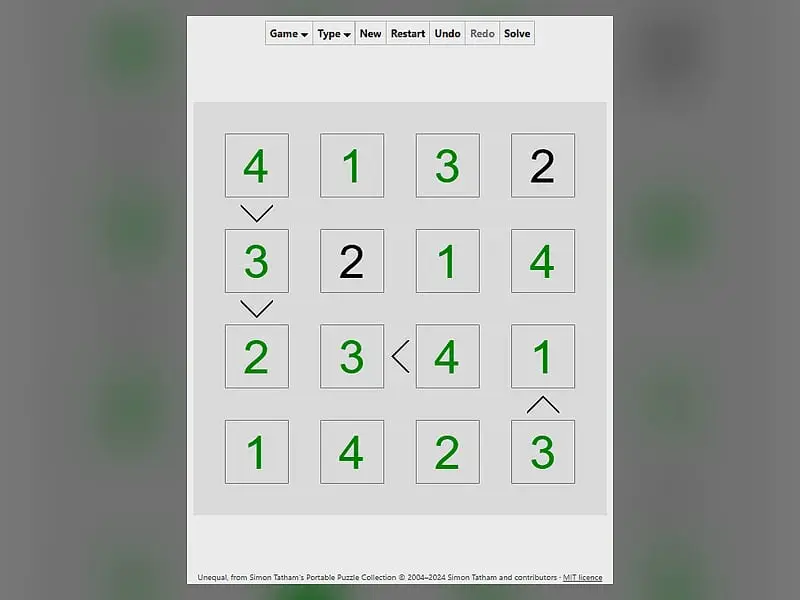
What is Greater-Than Grid?
Greater-Than Grid is a number logic puzzle on a square board. You place the digits 1 to N so no row or column repeats, and every inequality sign between two neighbors must point at the smaller one. An optional Adjacent mode swaps the signs for bars that mark digits exactly one apart.
- Category
- Puzzle Games
- Players
- 1 player
- Plays on
- Phone, tablet & desktop
- Input
- Mouse, Keyboard, Touch
- Made by
- James Harvey and Simon Tatham
- Checked
Greater-Than Grid looks like a plain number square until you notice the little arrows wedged between some of the cells. Those signs are almost the only clues you get. Your job is to place digits so each row and column holds every number once, and every sign tells the truth about its two neighbors. Known in Simon Tatham’s collection as Unequal and written by James Harvey, it also includes a second rule set with bars instead of signs. You can play the whole thing unblocked here, from tiny warm-up boards to seriously stubborn 7x7 grids.
How a Board Works
A board of size N uses the digits 1 through N. On a 5x5 grid, that means 1, 2, 3, 4 and 5 appear once in each row and once in each column.
Unequal mode. Signs between squares behave like less-than and greater-than symbols. On easier levels you get many signs; on harder ones, some are left out. A handful of squares may already hold digits.
Adjacent mode. Short bars replace the signs. A bar means the two digits are one apart. Every bar is drawn, so the absence of a bar is a clue as well: those two squares cannot hold neighbors like 2 and 3.
Click a square and type to place a digit, or right-click first to jot notes. When every rule is met, the grid flashes.
Greater-Than Grid controls
| To do this | Keyboard | Mouse | Touch |
|---|---|---|---|
| Write a digit | Arrow keys to move, then type the digit | Click a square, then type a digit | Tap a square, then tap a digit button |
| Toggle a small note | Enter switches the cursor to pencil mode, then type a digit | Right-click a square, then type a digit | Set Tap to Pencil mark (or press and hold a square), then tap a digit |
| Empty a square | Space, Backspace or 0 | — | Tap the square, then Clear |
| Auto-fill all notes / auto-fill and prune obvious clashes | M / H | — | — |
| Dim a sign you are done with | Shift or Ctrl + arrow key next to the clue | Click the sign | Tap the sign |
| New puzzle, undo, redo | N, U, R | Menu buttons above the grid | Menu buttons above the grid |
Reasoning Tricks Worth Learning
Rather than a checklist, here is how a typical solve unfolds.
Begin at the extremes. Any square on the small end of a sign can never be N, and any square on the big end can never be 1. On a 4x4 board that alone strips options from half the grid.
Next, follow chains. When three squares are linked by signs that all point the same way, the lowest must be at most N minus 2 and the highest at least 3. Longer chains squeeze even harder, and a chain of N squares fixes them all.
Look for a square that sits on the small side of every sign touching it. It is lower than all of its neighbors, which very often makes it a 1 or a 2. The reverse holds for squares on the big side of everything.
Then let the row and column rule finish the job. Once a 4 is placed, no other square in that line can be 4, and that often collapses a whole row.
In Adjacent mode, spend time on the missing bars. A 1 with no bars around it means none of its neighbors can be 2.
Pressing H early saves a lot of typing on 6x6 and 7x7 boards, and dimming used signs helps you see what is left.
Good For
This suits anyone who likes number placement puzzles but wants a twist beyond plain rows and columns. Sessions can be five minutes or forty, depending on size. If arithmetic clues appeal more, try Math Cage Grid, or test your sightline logic in Skyscraper Sightlines.
Greater-Than Grid: questions players ask
Which way does the sign point in Greater-Than Grid?
Read it like a math symbol. The wide open side faces the larger digit and the sharp tip faces the smaller one. So a sign between 2 and 5 opens toward the 5.
What is Adjacent mode?
Instead of signs, thin bars sit between some neighbors. A bar means the two digits differ by exactly one, like 4 and 5. All bars are shown, so neighbors without a bar are guaranteed not to be consecutive.
How hard do the puzzles get?
Presets start at a 4x4 board and climb to 7x7 Extreme, and difficulty runs from Trivial up to Recursive. Custom settings allow even larger grids if you want a long session.
Is there a hint or solve option?
There is a Solve button that fills in the answer, plus unlimited undo and redo. The H key works as a light helper, filling in notes and clearing the ones that clash with placed digits.
Credits and license
Greater-Than Grid was created by James Harvey and Simon Tatham and released as open source. FreezeNova hosts a lightly adapted copy on its own server, together with the original license file.
- Source code: git.tartarus.org/simon (original project)
- Code license: MIT
- Art & audio: MIT (all graphics are drawn by the game code; no images or audio)
- Our changes: Renamed for FreezeNova. This is the author's official web build minus its off-site links, resized for our player, with on-screen digit buttons added for touch. The puzzle code has not been altered.