Dominoes Unblocked
Line up 28 tiles end to end and be the first to play your last one.
What is Dominoes?
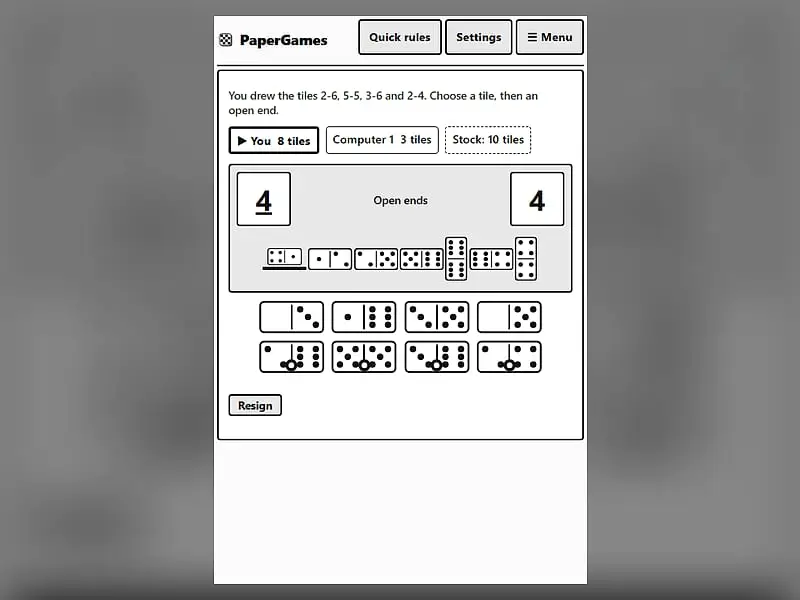
Dominoes is a tile-matching game that uses all 28 tiles of a standard double-six set. On each turn you add a tile showing the same number as one free end of the chain, or draw from the stock if nothing fits. The goal is to empty your hand first, or hold the fewest pips if the line gets blocked.
- Category
- Card & Board Games
- Players
- 1–2+ players (same screen)
- Plays on
- Phone, tablet & desktop
- Input
- Mouse, Touch
- Made by
- Christopher Müller
- Checked
Dominoes is one of those games almost every family owns, and this browser version plays the classic block-and-draw style with a full double-six set. Every tile carries two numbers, and the line grows only where numbers match, so each turn is a small puzzle about which tile to give up and which to hold. Up to four seats can be filled by people sharing one device or by computer opponents at three skill levels. It runs unblocked in any modern browser and is taken from the PaperGames project by Christopher Müller, where it goes by the name Domino.
The Rules at the Table
The 28 tiles are shuffled and dealt: seven each for two players, five each for three or four. The leftovers form the stock.
The biggest double in anyone’s hand goes down first. With no doubles dealt, the tile carrying the most pips starts instead. The status line tells you which tile opened, so you never have to sort that out yourself.
After that, play goes around the table. On your turn, add one tile to either free end; both end values are displayed in big boxes over the chain. Halves that meet must show the same number, so laying a 5-1 against an open 5 leaves a 1 showing at that end.
Can’t match anything? Keep drawing until a tile fits. Once the stock is empty and you are still stuck, you pass.
The round finishes as soon as one player lays down their final tile. It can also stall when every player passes in turn, and then the lightest hand wins.
Dominoes controls
| To do this | Mouse | Touch |
|---|---|---|
| Lay down a tile | Click a tile in your hand, then the open end it should go on | Tap a tile in your hand, then the open end |
| Take a tile from the stock | Click "Draw from stock" when nothing fits | Tap "Draw from stock" when nothing fits |
| Skip your turn | Click "Pass" once the stock is empty | Tap "Pass" once the stock is empty |
| Reveal your hidden hand | Click "Show my tiles" | Tap "Show my tiles" |
| Configure and deal a round | Choose mode, players, variant and level, then click "New game" | Choose mode, players, variant and level, then tap "New game" |
Thinking a Few Tiles Ahead
A good dominoes hand is less about luck than people think. These habits help every round:
Get rid of doubles while you can. A double matches just a single value, which makes it the piece most likely to get stranded.
Unload the heavy tiles. In a blocked game, a 6-6 left in your hand counts twelve against you. Light tiles are cheaper to keep.
Keep variety. A hand full of different numbers can answer far more of the ends your rivals leave you.
Notice who draws. When an opponent pulls from the stock against an open 4, they probably have no 4s. Keeping 4s on the ends can lock them out.
Count a number. Each value appears on exactly seven tiles. When five or six of them are already on the table, an end showing that value is close to dead, and you can use it to block.
Good for Quick Rounds and Family Play
A round takes only a few minutes, and the rules fit on a napkin, which makes this a nice game for younger players or a mixed group around one tablet. Solo players get a steady challenge from the Hard computers, and an optional hint setting highlights the playable tiles and their spots.
If you like matching tiles, Magnet Dominoes turns the idea into a logic puzzle. For another quick game around one screen, try Ludo.
Dominoes: questions players ask
How many tiles does each player get in dominoes?
A two-player game deals seven tiles per hand. Add a third or fourth player and each hand shrinks to five. Whatever is left becomes the face-down stock that players draw from when they cannot match an end.
Can I play dominoes with friends on one tablet?
Yes. Choose the same-device mode and set how many people are playing. Each hand stays covered until its owner taps the button to reveal it, so you can pass the tablet around without peeking.
What happens when the dominoes line is blocked?
If every player passes in a row and the stock is empty, nobody can continue. Everyone counts the dots left on their tiles, and the smallest sum takes the round. Two players tied for lowest means a draw.
Is there more than one way to play?
There is a second variant called Triangles. It uses 56 three-sided tiles, with a value between 0 and 5 in every corner. You fit them together on a grid so neighboring corners agree, and when stuck you may take as many as three tiles before passing.
Does this dominoes game keep score across rounds?
No. Each game is a single round with one winner, and there is no running points table. The current round does survive a reload, since it is kept in local storage on your device.
Credits and license
Dominoes was created by Christopher Müller and released as open source. FreezeNova hosts a lightly adapted copy on its own server, together with the original license file.
- Source code: github.com/YourChaosChris (original project)
- Code license: MIT
- Art & audio: MIT (tiles drawn with SVG and CSS, no image or audio files)
- Our changes: This page uses only the Domino game from PaperGames, shown in English. We removed the offline service worker, the site menu bar and the links to other games and pages. Rules and computer players are as the author published them.