Black Box Lasers Unblocked
Every beam is a question. Read what comes back and map the balls you cannot see.
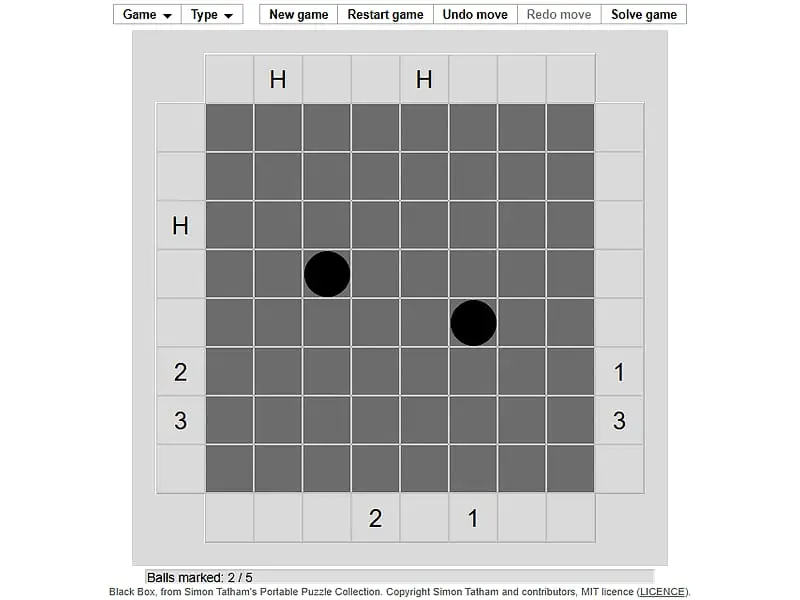
What is Black Box Lasers?
Black Box Lasers is a single-player deduction puzzle on a dark square grid that hides several balls. You fire beams in from the edge and note whether each one is absorbed, sent back, or exits somewhere else. The goal is to mark the exact layout of the balls using those results, ideally with as few shots as possible.
- Category
- Puzzle Games
- Players
- 1 player
- Plays on
- Phone, tablet & desktop
- Input
- Mouse, Keyboard, Touch
- Made by
- James Harvey (Simon Tatham's Portable Puzzle Collection)
- Checked
Black Box Lasers is a puzzle about seeing without looking. A few balls sit somewhere inside a sealed grid, and your only tool is a laser you can aim in from any edge square. Each beam reports back in a tiny code: swallowed, bounced home, or exiting at a numbered spot elsewhere. Piece enough of those reports together and the hidden layout snaps into focus. You can play it unblocked here, a browser build of James Harvey’s entry in Simon Tatham’s puzzle collection, itself based on a 1970s board game by Eric Solomon.
What a Beam Can Tell You
A laser travels in a straight line until a ball interferes. There are only a few possible outcomes, and learning them is most of the game.
Absorbed (H). If a ball sits directly in the beam’s path, the beam stops there and never comes out. The edge square shows an H.
Turned aside. When a ball is diagonally ahead of the beam, the beam swings 90 degrees away from it. One shot can turn several times before it leaves.
Sent back (R). A beam that ends up leaving through the square it entered gets an R. This also happens if a ball sits diagonally next to the entry square, because the beam is deflected before it even starts.
Matched exit. Any other beam leaves somewhere else, and the same number is written at both ends so you can pair them up.
Once you think you know the layout, click inside the grid to drop markers. When your marker count equals the number of hidden balls, a button appears in the top left corner to check the answer. The status bar keeps a running tally of marked against hidden balls. The default box is 8x8 with five balls.
Black Box Lasers controls
| To do this | Keyboard | Mouse | Touch |
|---|---|---|---|
| Send a beam into the box | Arrow keys to an edge square, then Enter | Left-click a square on the edge | Tap a square on the edge |
| Mark or unmark a suspected ball | Arrow keys inside the box, then Enter | Left-click inside the box | Tap inside the box |
| Lock a cell, or a full row or column | Space | Right-click a square, or an edge square for its whole row or column | Press and hold |
| Submit your layout for checking | Move to the button in the top left corner, then Enter | Click the button that appears in the top left corner | Tap the button that appears in the top left corner |
| Undo, redo or start a fresh box | U / R / N | Undo move, Redo move and New game buttons | Undo move, Redo move and New game buttons |
Reasoning Like a Detective
A good session follows a rough rhythm.
- Open with a central shot. A beam fired down the middle row or column covers the most ground and usually triggers something.
- Chase every H. An absorbed beam means a ball lies on that line, perhaps after a turn. Fire across that line from a side to narrow it down.
- Never read R in only one way. A diagonal ball beside the entrance and a beam that looped all the way round produce the same letter.
- Distrust a clean pass-through. A beam that comes straight out the far side often means an empty lane, but two turns can cancel each other out. Confirm with a crossing shot.
- Lock what is proven empty. Right-clicking an edge square locks a whole row or column, so a careless click cannot drop a marker there.
The real challenge is economy. Anyone can fire every beam and solve by brute force. Try to finish with a handful of shots instead, and undo freely when you want to replay a line of thought.
One clever touch: when there are more than four balls, two different layouts can give identical beam results. The checker compares results rather than exact cells, so any layout consistent with every possible shot is accepted.
Where It Fits on FreezeNova
This one suits players who enjoy slow, careful logic more than speed. There is no timer, and a single box can take two minutes or twenty. If hidden-object deduction appeals to you, the minefield reasoning in Logic Mines is a close cousin, and Bulls and Cows uses the same idea of reading coded feedback to crack a secret.
Black Box Lasers: questions players ask
How do you solve Black Box Lasers without guessing?
Treat each result as a constraint. An H puts a ball on that beam's route, an R limits the cells near the entry, and a matched pair of numbers tells you the beam bent between two points. Combine three or four of these and most balls have only one possible home.
Can I make the box bigger or add more balls?
Yes. The Type menu offers presets from a small 5x5 box with three balls up to 10x10 boxes holding as many as ten, and a custom option lets you set your own width, height and ball count.
What does the game do if my answer is wrong?
It does not reveal the full solution. Instead it either circles one of your earlier shots that contradicts your layout, or shows one extra beam in red that your guess cannot explain, and you keep working.
Is Black Box Lasers playable on a school Chromebook?
It should be. The puzzle runs from FreezeNova's own server in the browser with nothing to install, and it works with a trackpad, the keyboard cursor, or a touch screen.
Credits and license
Black Box Lasers was created by James Harvey (Simon Tatham's Portable Puzzle Collection) and released as open source. FreezeNova hosts a lightly adapted copy on its own server, together with the original license file.
- Source code: git.tartarus.org/simon (original project)
- Code license: MIT
- Art & audio: MIT (all graphics are drawn by the game code; no images or audio)
- Our changes: We gave the puzzle a new name, switched to the author's official web build, took out links pointing away from this site, sized it to fit our player and made press-and-hold work on touch screens. The puzzle logic itself is untouched.