Galaxies Symmetry Puzzle Unblocked
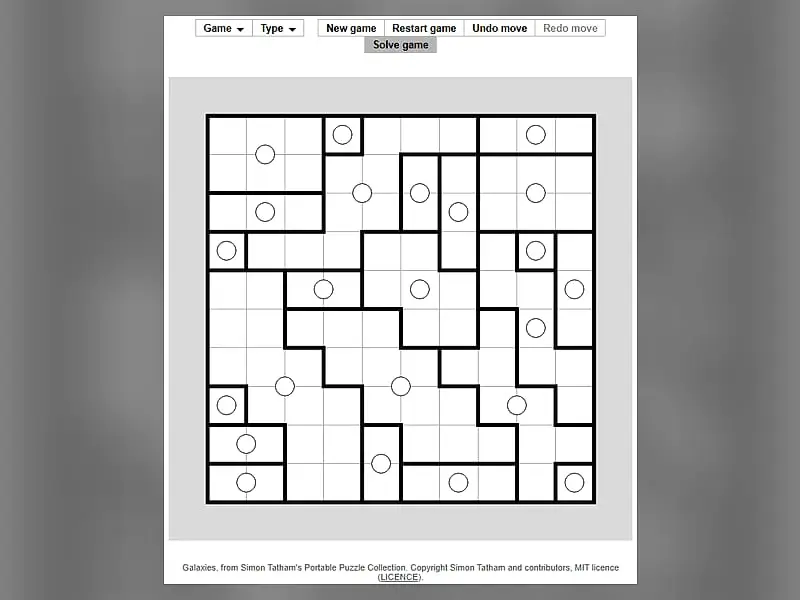
Every dot is the hub of a shape that looks the same upside down. Find all the borders.
What is Galaxies Symmetry Puzzle?
Galaxies Symmetry Puzzle is a logic puzzle where you draw walls along grid lines to divide the board into regions. Each region holds exactly one dot, and that dot must be its center of rotation. You solve it when every region would look identical after a 180-degree turn around its dot.
- Category
- Puzzle Games
- Players
- 1 player
- Plays on
- Phone, tablet & desktop
- Input
- Mouse, Keyboard, Touch
- Made by
- James Harvey and Simon Tatham
- Checked
Galaxies Symmetry Puzzle hands you an empty grid with dots scattered across it and one clean rule: cut the board into shapes so that each shape spins around its own dot and lands back on itself. There are no numbers to add up and no colors to match, just geometry and patience. James Harvey wrote it for Simon Tatham’s puzzle collection, and every board is checked by a solver before it reaches you. This unblocked copy keeps all the original sizes and both difficulty settings.
The Shape of a Galaxy
Each square on the board ends up inside exactly one galaxy, and each galaxy owns exactly one dot. Picture sticking a pin through the dot and turning the shape halfway round. If the outline matches itself, it is symmetric, and that is what every galaxy needs.
You mark the answer by placing walls on the lines between squares. A galaxy is valid when its outline is closed, its single dot sits at the true center, it is symmetric and no leftover walls cut through its middle. Valid galaxies light up as you go, which gives you a running check. The puzzle ends when the only walls left are the ones dividing one galaxy from the next.
Boards come in 7x7, 10x10 and 15x15, each at Normal or Unreasonable. A Custom option lets you pick any size and difficulty.
Galaxies Symmetry Puzzle controls
| To do this | Keyboard | Mouse | Touch |
|---|---|---|---|
| Add or remove a wall | Arrow keys to move, then Enter on a line | Left-click the line | Tap the line |
| Pull a note arrow out of a dot | Enter on a dot to pick up, Enter again to drop | Right-drag from the dot to a square | Press and hold the dot, then drag |
| Reposition or discard an arrow | — | Right-drag it elsewhere, or off the grid | Press and hold it, then drag |
| New board, undo, redo | N, U, R | Menu buttons above the grid | Menu buttons above the grid |
Working a Board From Scratch
Start with the forced walls. If two dots sit in the centers of side-by-side squares, those squares cannot share a galaxy, so the line between them must be a wall. Sweep the board for these first.
Pair every square with its twin. Whenever you decide a square belongs to a dot, the square mirrored through that dot belongs to it as well. If the twin would fall off the board or onto another dot’s turf, the first square cannot belong there.
Hunt for squares with one option. Tucked-away corners often have only one dot whose mirror image fits. Claim them early and the edges of the puzzle firm up.
Leave yourself notes. Drag an arrow out of a dot and drop it on a square you have assigned but not yet fenced in. The arrow keeps pointing back to its dot even as you move it.
Trust the shading. A closed region that refuses to light up usually has a hidden inner wall or a square whose twin is missing.
Save Unreasonable for when Normal feels routine, since it can demand trial and error.
Why It Stands Apart
Most grid puzzles are about counting. This one is about seeing, and the moment a lopsided blob suddenly snaps into a neat pinwheel is very satisfying. It suits players who like spatial reasoning more than arithmetic. For more line-drawing logic, try Loopy Loop Puzzle or the diagonal grid of Slant Diagonals.
Galaxies Symmetry Puzzle: questions players ask
How do I know a galaxy is finished?
The game shades a region as soon as it is closed, contains one dot at its center, is symmetric about that dot and has no stray walls inside. If a shape you think is done stays plain, one of those conditions is broken.
Do Galaxies puzzles ever need guessing?
Normal boards are built to fall to pure deduction. Unreasonable boards can require trying a branch and backing out, so lean on the unlimited Undo there.
Why are some dots on lines instead of inside squares?
A dot's spot tells you about the middle of its galaxy. Inside a square, the center is that square. On an edge, the center is a domino of two squares. On a corner, it is a block of four.
Can I play Galaxies Symmetry Puzzle on an iPad or phone?
Yes. Tap lines to place walls and press and hold a dot to drag a note arrow. For the 15x15 boards, rotating the screen sideways makes each square easier to hit.
Credits and license
Galaxies Symmetry Puzzle was created by James Harvey and Simon Tatham and released as open source. FreezeNova hosts a lightly adapted copy on its own server, together with the original license file.
- Source code: git.tartarus.org/simon (original project)
- Code license: MIT
- Art & audio: MIT (all graphics are drawn by the game code; no images or audio)
- Our changes: Given a new name here. We run the author's official browser build without its off-site links, scaled it to our frame and added touch dragging for the arrows. The puzzle logic itself is untouched.