Snakes and Ladders Unblocked
Climb up, slide down and hope the die is kind on the last row.
What is Snakes and Ladders?
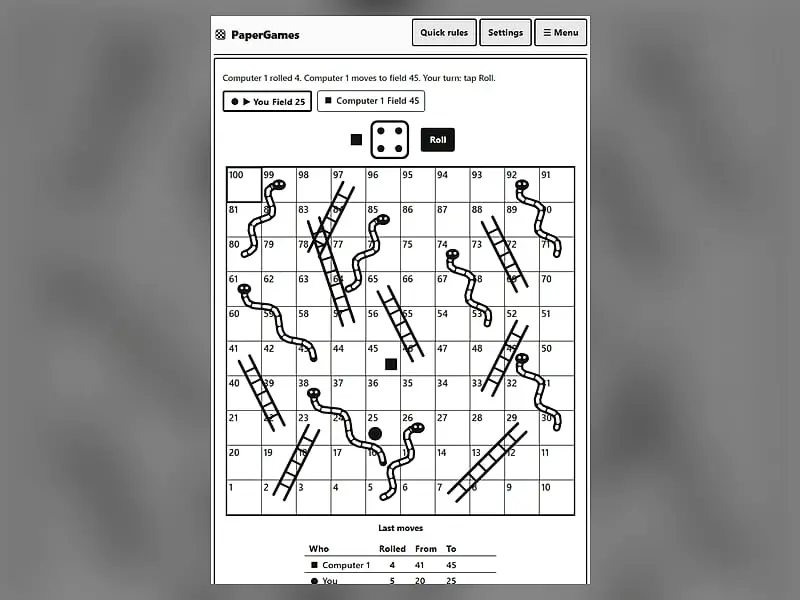
Snakes and Ladders is a luck-based dice race for two, three or four players on a numbered board that zigzags upward. You roll and move your token forward, climbing any ladder you stop at and sliding down any snake whose head you land on. The first token to reach the final field wins, and pure luck decides the result.
- Category
- Card & Board Games
- Players
- 1–2+ players (same screen)
- Plays on
- Phone, tablet & desktop
- Input
- Mouse, Touch
- Made by
- Christopher Müller
- Checked
Snakes and Ladders was, for many of us, the game we played before we could read the rules, and it still has the same pull: one roll can lift you halfway up the board, and the next can drop you right back down. There are no decisions to agonize over, which is the whole point. This unblocked version from the PaperGames project by Christopher Müller draws the board in crisp black and white, comes with a big 100-field board and a compact 50-field version for little ones, and seats two, three or four players on one device, with the computer free to take any seat.
How a Game Unfolds
Before you start. Open the setup and choose:
- the board: 100 fields with eight snakes and eight ladders, or 50 fields with four of each
- the number of players, and which seats the computer fills
- who goes first and your token shape, chosen from a circle, a square, a triangle and a star
- the finish rule: overshooting still wins, or an exact roll is needed
On the board. Every token begins off the board and joins on its first roll. Numbers zigzag upward from the bottom-left corner, running rightward on one row and leftward on the row above.
Your turn. Tap Roll. Your token walks forward by the number shown, all on its own. Stop at the bottom of a ladder and you climb straight to its top. Stop on a snake’s head and you slide down to its tail.
Keeping track. Each climb and slide is announced in the status text, and a short log beneath the board records recent turns with the player, the roll, and the start and end fields.
Whoever arrives on the final field first wins.
Snakes and Ladders controls
| To do this | Mouse | Touch |
|---|---|---|
| Throw the die | Click "Roll" | Tap "Roll" |
| Let the computer player move | Click "Continue" | Tap "Continue" |
| Configure the next game | Choose board, finish rule, players, computers and who starts, then click "New game" | Choose board, finish rule, players, computers and who starts, then tap "New game" |
| Reopen the setup during play | Click "Menu" | Tap "Menu" |
Making It Work for Kids
Since there is no strategy, the useful tips are about the experience.
- Start young players on the 50-field board. Shorter games end before attention wanders.
- Keep computer turns on tap-to-continue. Children get time to watch where each token goes and why.
- Use the move table as a counting lesson. After a big climb or slide, read the roll and both field numbers out loud together.
- Let each child choose a shape. A star or triangle is easier to follow than a color on a busy board.
- Turn on the exact-finish rule for older kids. Requiring a precise roll to finish keeps everyone in the game until the last throw.
A Gentle Board Game for Everyone
This is the easiest game in our board collection to pick up, and it is ideal for a parent and child sharing a tablet or a classroom playing in small groups. Your unfinished game stays stored in the browser, so you can stop for dinner and pick it up later.
When the kids are ready for a race with a few real choices, move on to Ludo. For a memory challenge that also suits young players, try Memory Pairs.
Snakes and Ladders: questions players ask
Is Snakes and Ladders all luck?
Yes. Every move is decided by the die, and the game moves your token for you. That is exactly why it works for young children, since anyone can win, and nobody needs to know any strategy to play.
Can one person play Snakes and Ladders alone?
Yes. Set one human player and let the computer run one to three other tokens. Computer turns wait for a tap on Continue by default, or you can switch them to move automatically.
Do you have to land exactly on the last square?
That depends on the finish rule you pick before the game. One rule lets any roll that passes the end count as a finish. The other requires the exact number, so a roll that is too big means your token stays put.
Which board is better for small children?
The 50-field board. With half as many rows and only four snakes and four ladders, a game ends sooner and the route is much easier for a young player to follow with a finger.
Credits and license
Snakes and Ladders was created by Christopher Müller and released as open source. FreezeNova hosts a lightly adapted copy on its own server, together with the original license file.
- Source code: github.com/YourChaosChris (original project)
- Code license: MIT
- Art & audio: MIT (board, snakes and ladders drawn with SVG and CSS, no image or audio files)
- Our changes: We took only this game from PaperGames and set its text to English. The offline service worker, the language picker and the links to the other games and pages were removed. The rules and both boards are unchanged.