Spider Solitaire Unblocked
Ten columns, two decks and eight same-suit runs between you and a cleared table.
What is Spider Solitaire?
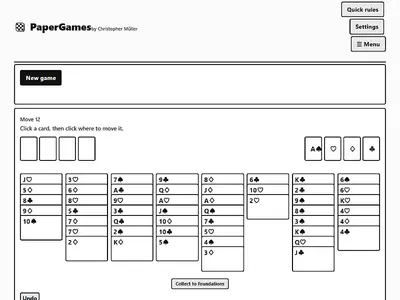
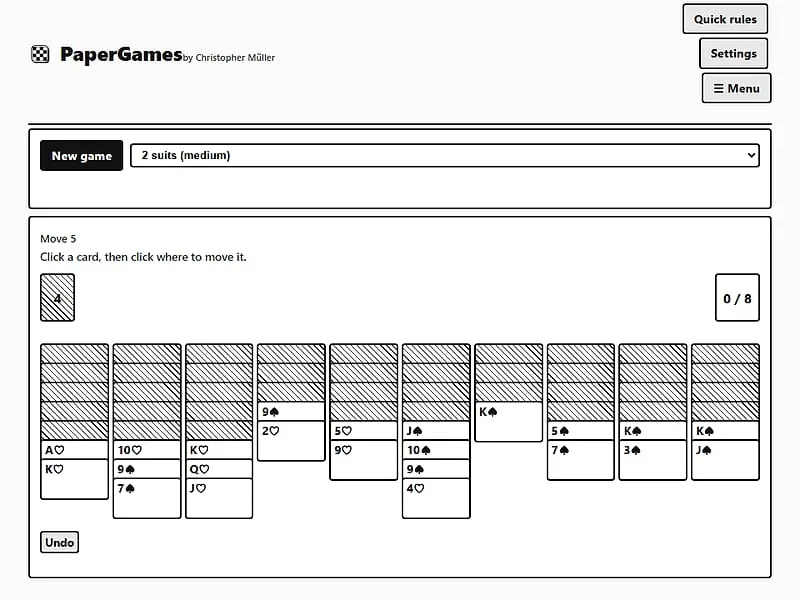
Spider Solitaire is a two-deck patience game for one player. Fifty-four cards are dealt into ten columns and the rest stay in a stock that deals a new row when you get stuck. The goal is to assemble eight complete runs, each a same-suit sequence running from King to Ace, which clear the table automatically.
- Category
- Card & Board Games
- Players
- 1 player
- Plays on
- Phone, tablet & desktop
- Input
- Mouse, Touch, Keyboard
- Made by
- Christopher Müller
- Checked
Spider Solitaire is the long-form patience game: a doubled deck, a ten-column table and a stock that keeps dropping new cards on you just when the table starts to look tidy. It rewards patience more than speed, and the suit setting lets you choose how hard it bites. With one suit it is a relaxing sort; with four it becomes a genuine puzzle. This unblocked version from the PaperGames project by Christopher Müller offers all three suit counts, unlimited undo and full keyboard support, and it saves your deal between visits.
Building Runs With Two Decks
The deal. 104 cards are used. Columns one to four get six cards apiece and columns five to ten get five, 54 in all, with only the last card of each column face up. The remaining 50 sit in the stock.
Placing single cards. A card may sit on anything one step above it in rank, whatever the suit. A 9 of clubs fits on a 10 of hearts. Any card, or any movable group, can go into an empty column.
Moving groups. This is the catch. A group of cards travels together only if it is a descending run in one suit. A run that mixes suits must be taken apart card by card.
Dealing. When you are stuck, tap the stock to place one face-up card on every column. You get five deals, and the game will not deal while any column is empty.
Clearing. Complete a thirteen-card sequence in a single suit, from King to Ace, and it lifts off the table automatically. Eight such sequences win the game. A move counter records your effort.
Spider Solitaire controls
| To do this | Keyboard | Mouse | Touch |
|---|---|---|---|
| Lift a card or a single-suit run | Arrow keys to move between cards, then Enter or Space | Click the card | Tap the card |
| Place it on a column | Arrow keys to the column, then Enter | Click the column | Tap the column |
| Deal a fresh row of ten | — | Click the stock pile (it shows the deals left) | Tap the stock pile |
| Reverse the last move or deal | — | Click "Undo" | Tap "Undo" |
| Choose a suit count and redeal | — | Pick 1, 2 or 4 suits, then click "New game" | Pick 1, 2 or 4 suits, then tap "New game" |
Strategy From the Opening to the Last Deal
Opening
Turn over face-down cards as fast as you can. Each one you reveal adds choices, and the four left-hand columns hide the most. Moves that expose a card usually beat moves that only tidy up.
Middle game
Stay in suit whenever there is a choice. Placing a 7 of spades on an 8 of spades keeps a run you can move later; placing it on an 8 of hearts creates a mixed stack that sticks. Treat an empty column as your most valuable tool. With it you can dismantle a mixed stack one card at a time and rebuild it by suit, so give it up only for a clear gain.
Before each deal
Make every useful move first. Each deal covers all ten columns at once and may smother a run that was nearly done. If you can expose one more card or join two runs, do it before you tap the stock.
Learning curve
Start on one suit until it feels routine, then move to two. Four suits is a big step and much more about careful planning with Undo.
Why Spider Keeps People Coming Back
Few solitaires scale as well. The same rules give a calm ten-minute session or a long, thoughtful battle, depending on one setting. Finished runs vanish with a satisfying count toward eight, and nothing is lost if you close the tab halfway.
If you prefer a game where every card is visible from the start, try FreeCell Solitaire. For a classic single-deck alternative, Klondike Solitaire is the obvious companion.
Spider Solitaire: questions players ask
Is one-suit Spider Solitaire easy to win?
It is the most forgiving mode, since every card belongs to the same suit and any descending run can move together. Most careful players win one-suit games regularly. Two suits is noticeably harder, and four suits is a real test.
Why won't the stock deal more cards?
Every column needs at least one card before a deal is allowed. Put something, even a single card, into the gap and try the stock once more. The pile shows how many of its five deals are left.
What happens when I finish a King-to-Ace run?
The finished sequence disappears on its own and the tally in the corner rises by one. Reach eight of eight and the game is won.
Does Spider Solitaire work on mobile?
Yes. The full set of ten columns fits the width of the screen and works with taps, though cards are narrow on a phone held upright. Rotating to landscape gives each column more breathing room.
Will my Spider Solitaire game be saved?
Yes. The current deal is stored in your browser and returns when you come back on the same device, so a long four-suit game can be finished over several sittings.
Credits and license
Spider Solitaire was created by Christopher Müller and released as open source. FreezeNova hosts a lightly adapted copy on its own server, together with the original license file.
- Source code: github.com/YourChaosChris (original project)
- Code license: MIT
- Art & audio: MIT (cards drawn in code with text ranks and inline SVG suits; no image or audio files)
- Our changes: We extracted Spider from the PaperGames collection as a stand-alone page in English only, removing the service worker, the language menu and the links to other parts of the app. Gameplay is unchanged.