Train Track Logic Unblocked
Lay a single railway from A to B that hits every row and column count exactly.
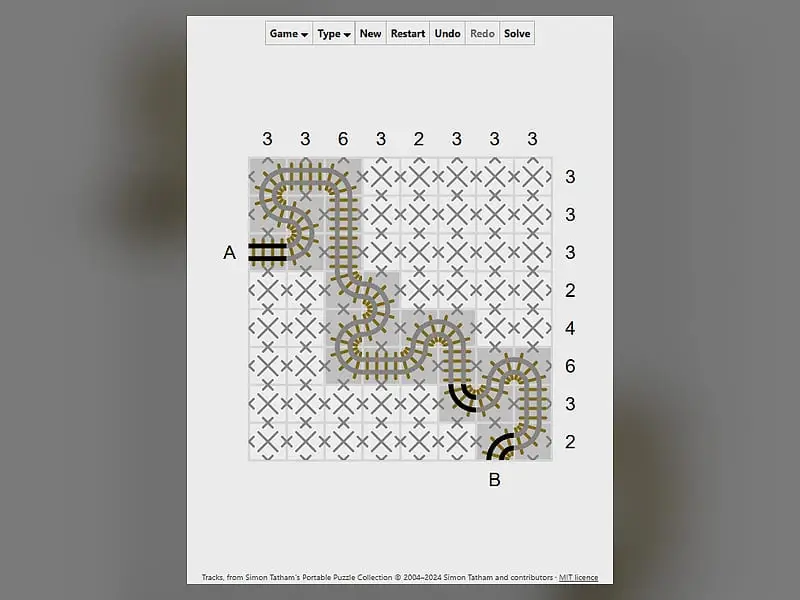
What is Train Track Logic?
Train Track Logic is a single-player railway puzzle on a grid. You lay one continuous track from A, on the west side, to B, on the south side, built from straights and quarter-turn bends. Numbers beside each row and column say how many squares in that line hold track, and your route must match all of them.
- Category
- Puzzle Games
- Players
- 1 player
- Plays on
- Phone, tablet & desktop
- Input
- Mouse, Keyboard, Touch
- Made by
- James Harvey and Simon Tatham
- Checked
Train Track Logic asks you to finish a railway that someone started and abandoned. Its endpoints, labelled A and B, are shown, and a handful of rails were laid before you arrived. Clues above the grid and down its right side give the exact number of track squares for every column and row. You must join A and B with a single route that agrees with all of them. It is James Harvey’s Tracks puzzle from Simon Tatham’s collection, and here you can play it unblocked in any browser.
Laying the Line
The line comes in through A on the west side and leaves through B along the southern edge. In between, every piece is either a straight or a right-angle bend. It cannot branch, cross itself or loop around.
Each clue counts squares that contain any track, whether that is a straight or a curve. Pieces printed at the start always belong to the final answer.
Clicking the border shared by two neighbouring squares puts rails across it and links them. A right-click on that border crosses it off instead. Clicking in the middle of a square places a colored note that says some track goes through, and right-clicking places a cross for an empty square. Sweeping across several squares notes a whole stretch at once. Overfilled lines show their clue in red, and a finished railway makes the board flash.
Train Track Logic controls
| To do this | Keyboard | Mouse | Touch |
|---|---|---|---|
| Lay rails across an edge | Move onto an edge with the arrows, then Enter | Left-click the edge between two squares | Tap the edge with Tap set to Track |
| Cross out an edge | Space on an edge | Right-click the edge | Press and hold the edge, or switch Tap to Cross |
| Note a square as track or no track | Enter or Space on a square | Left-click or right-click inside the square | Tap or press and hold inside the square |
| Mark a run of squares at once | — | Left- or right-drag across them | Drag, holding first for crosses |
| New puzzle, undo, redo | N, U, R | Buttons above the grid | Buttons above the grid |
How to Think Like a Track Planner
Settle the extremes. A row or column with a 0 has no track at all. One whose clue equals its full length is track from end to end. Mark both kinds before anything else.
Two edges per square. Any square carrying rail connects through precisely two sides. Once you have crossed out two edges, the remaining two are the rails. Once two are railed, cross out the rest.
Follow the given pieces. Each pre-placed rail aims at a neighbour, and that neighbour needs rail too. Extend each one as far as the logic allows.
Fill a finished line with crosses. Once a row hits its number, drag crosses across its leftover squares. It keeps the board readable and stops accidental extra track.
Watch out for closed circuits. A loop can satisfy local counts but never connects A and B. If two route segments are about to meet, check that they aren’t the same segment.
Plan the turns. If the track must reach a far column, it has to curve toward it somewhere. Counting the turns you need narrows where they can go.
Why It Stands Out
Train Track Logic feels more physical than most number grids. You are drawing an actual route, so mistakes are easy to see, and the satisfaction of watching the line snake across the map is real. A dozen presets go from 8x8 all the way to 15x15, and custom sizes exist for anything else.
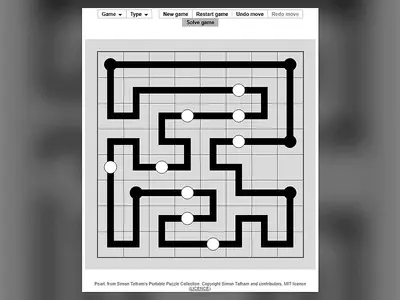
If you like path puzzles, Pearl Loop Puzzle builds a closed ring instead of an open line. For pipe-connecting fun, try Net Pipe Puzzle.
Train Track Logic: questions players ask
Where does the railway begin in Train Track Logic?
A is on the western edge and B is on the southern edge. Both of those border squares come with a rail already laid, so you always know where the route touches the outside.
Can the track loop or split?
No. It is one continuous line with no crossings, branches or loops. Each square either has no rail or a single piece joining two of its four sides, either straight or a quarter turn.
Why mark squares instead of laying track?
Often you can prove a square is used long before its direction is clear. A square marker records that fact without committing to a direction, and a cross records that no track goes there.
Which preset should I try first?
An 8x8 Easy map is the gentlest start. Twelve presets in total cover five board sizes and three levels named Easy, Tricky and Hard, so there is plenty of room to step up.
Credits and license
Train Track Logic was created by James Harvey and Simon Tatham and released as open source. FreezeNova hosts a lightly adapted copy on its own server, together with the original license file.
- Source code: git.tartarus.org/simon (original project)
- Code license: MIT
- Art & audio: MIT (all graphics are drawn by the game code; no images or audio)
- Our changes: New name for FreezeNova. We use the author's official web build with outside links removed, fit it to our player and added touch dragging and press and hold. The puzzle code is original.