Dominosa Domino Logic Unblocked
Only the numbers remain. Work out where every domino was lying.
What is Dominosa Domino Logic?
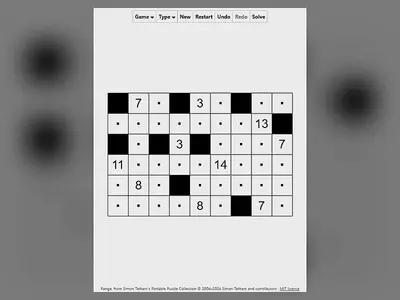
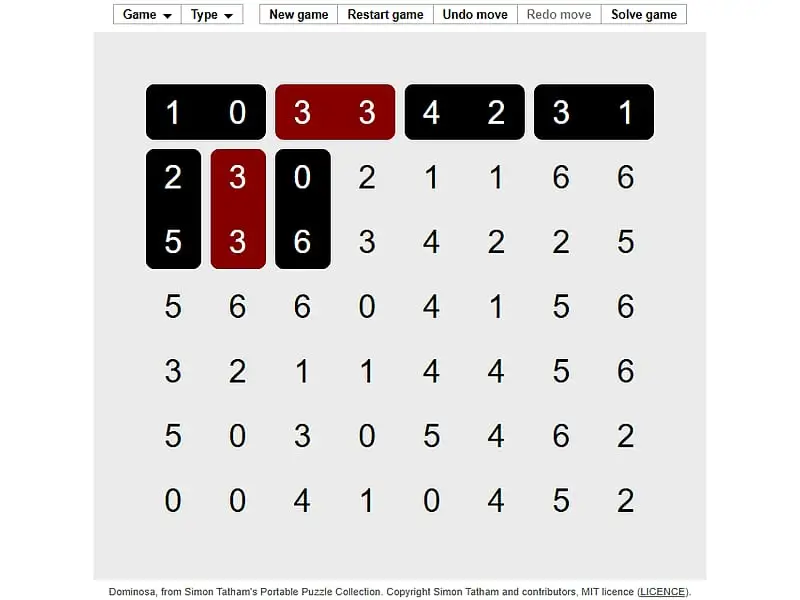
Dominosa Domino Logic is a logic puzzle built from a grid of numbers. A complete double set of dominoes once covered the grid, and you must place dominoes over pairs of neighboring numbers so that every possible pair, including doubles, appears exactly once. The standard set uses 0 to 6, giving 28 dominoes.
- Category
- Puzzle Games
- Players
- 1 player
- Plays on
- Phone, tablet & desktop
- Input
- Mouse, Keyboard, Touch
- Made by
- Simon Tatham
- Checked
Dominosa Domino Logic is a puzzle of reconstruction. Imagine someone tipped a full box of dominoes onto a table, arranged them into a neat rectangle, copied every number onto paper, and then swept the tiles away. That paper is all you get. From it you must work out where each domino lay, knowing that the set contained every pair exactly once. It is Simon Tatham’s version of a puzzle usually credited to O. S. Adler, and it plays unblocked in your browser with mouse, keyboard or touch.
The Set and the Grid
The default board uses the numbers 0 to 6. One domino exists for every pair, doubles included, so the set holds 28 dominoes and fills an 8x7 grid. Each domino covers two squares that sit side by side or one above the other.
Clicking the boundary shared by two neighboring numbers puts a domino over them. Click it again to lift it. Laying a domino across squares already in use removes the old ones automatically. A right-click on a boundary marks it with a small stroke, your own reminder that no domino may sit there.
The board is complete once all cells are filled and each pair shows up a single time. Any repeated pair turns red at once.
Four difficulty levels, Trivial, Basic, Hard and Extreme, control how deep the logic goes. All of them have a single correct answer.
Dominosa Domino Logic controls
| To do this | Keyboard | Mouse | Touch |
|---|---|---|---|
| Lay or lift a domino | Arrow keys to a spot between two numbers, then Enter | Left-click between two neighboring numbers | Tap between two neighboring numbers |
| Draw or erase a "not here" line | Space | Right-click between two numbers | Press and hold between two numbers |
| Light up every copy of a number | Type the number | Right-click on the number | Press and hold on the number |
| Undo, redo or deal a new grid | U / R / N | Undo move, Redo move and New game buttons | Undo move, Redo move and New game buttons |
A Solver’s Toolkit
Most Dominosa logic comes down to two questions asked over and over: where can this square go, and where can this pair go?
Squares with one exit. A square in a corner, or one boxed in by placed dominoes, may have only one free neighbor left. It has to pair with that neighbor.
Pairs with one home. Choose a pair, such as 1-4, and scan the grid for every place a 1 sits next to a 4. If there is only one, place it. Typing a number highlights all of its copies, and you can highlight two numbers at a time, which makes this scan quick.
Clean up after each placement. When a pair is used, mark off each remaining place that pair might have fitted. Those lines often leave neighboring squares with a single exit, which starts the next chain.
Doubles are rare. Two equal numbers next to each other are the only candidate for that double, unless the same double appears elsewhere. Check doubles early.
Late game. On Hard and Extreme, simple scanning eventually stalls. Look for a pair with exactly two possible spots that share a square. Whichever spot is right, that square belongs to this pair, so you can rule out every other domino that would cover it.
Why It Clicks
The rules fit in one sentence, yet the bigger sets feel like untangling a knot. If you like this style of number logic, try Magnet Dominoes for another domino-based grid, or Math Cage Grid for arithmetic deduction.
Dominosa Domino Logic: questions players ask
How do you start a Dominosa puzzle?
Look for squares that have only one free neighbor, such as a corner square next to a square already covered. That pair must be a domino. Then search for pairs of numbers that occur next to each other in only one place on the whole grid.
Is there always exactly one solution?
On the four normal difficulty levels, yes. Only the Ambiguous setting in the Custom menu allows boards with more than one valid answer.
Why are two of my dominoes red?
You have used the same pair twice, for example two 2-5 dominoes. A set has only one of each, so at least one of them is in the wrong place.
Can I make the puzzle bigger?
Yes. The Type menu ranges from a tiny set topping out at 3 to a big one running to 9. In general, if the highest number is N, the grid measures N+2 columns by N+1 rows.
Credits and license
Dominosa Domino Logic was created by Simon Tatham and released as open source. FreezeNova hosts a lightly adapted copy on its own server, together with the original license file.
- Source code: git.tartarus.org/simon (original project)
- Code license: MIT
- Art & audio: MIT (all graphics are drawn by the game code; no images or audio)
- Our changes: Given a new name on FreezeNova. We run the author's official web build, removed links that lead elsewhere, fitted the board to our player and made press-and-hold work on touch screens. The puzzle code is untouched.