Slant Diagonals Unblocked
Fill every square with a slash or backslash, and never let the lines close a loop.
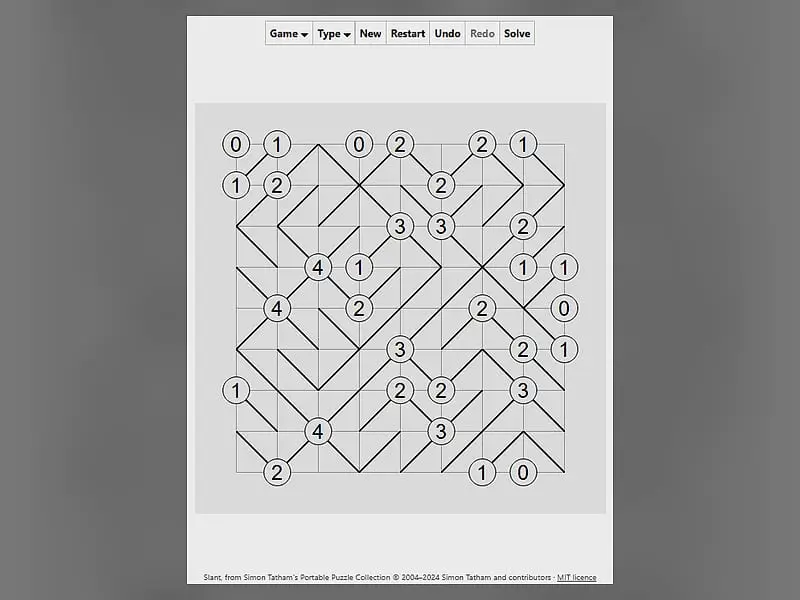
What is Slant Diagonals?
Slant Diagonals is a single-player logic puzzle where every square gets one diagonal line, leaning left or right. Circled numbers on grid corners show how many lines must touch that point. The goal is to fill the whole grid so all clues are met and the lines never form a closed loop.
- Category
- Puzzle Games
- Players
- 1 player
- Plays on
- Phone, tablet & desktop
- Input
- Mouse, Keyboard, Touch
- Made by
- Simon Tatham
- Checked
Slant Diagonals sounds almost too plain to be a puzzle: every square needs a single diagonal line, either / or . Then two rules arrive. Circled numbers sitting on grid corners tell you how many lines must touch each point, and the lines must never join up into a closed loop, no matter how large. Balancing local counts against that global no-loop rule is what keeps this puzzle interesting long after you learn it. The puzzle is Slant, part of Simon Tatham’s collection, and it is playable unblocked on any browser.
Slashes, Corners and the No-Loop Rule
A backslash links a square’s upper-left and lower-right corners, while a forward slash links its upper-right and lower-left. A finished grid has no empty squares.
Clues live on the points where squares meet. An inner point is shared by four squares, and its number says how many of their diagonals reach it. So a 4 sits where an X meets, while a 1 means three of the four lines lean away.
The loop rule is the one that bites. If your diagonals ever enclose an area, the board is wrong. The game highlights loops and impossible clues in a warning color, which helps you catch an error before it spreads.
Left-click places a , right-click places a /, and further clicks swap the direction and then blank the square. A solved grid flashes.
Slant Diagonals controls
| To do this | Keyboard | Mouse | Touch |
|---|---|---|---|
| Place a \ line (repeat to cycle) | Arrows to move, then Enter | Left-click a square | Tap a square while Tap is set to "\ first" |
| Place a / line (repeat to cycle) | Space | Right-click a square | Press and hold, or switch Tap to "/ first" |
| Set a direction or clear the square | Type / or \, or Backspace to empty | — | — |
| New puzzle, undo, redo | N, U, R | Buttons above the grid | Buttons above the grid |
Things I Wish I Had Known Earlier
Edges are generous. Border clues have just two squares around them, and a corner clue has one. A 0 or 2 on the border fixes both lines right away.
Every line affects two clues. A diagonal touches two opposite corners of its square. After you place one, check both ends. Often a clue becomes full, and then the rest of its squares must lean away from it.
Three sides of a diamond is a warning sign. If three squares already outline most of a tiny diamond, the last one has to tilt the opposite way, or you close a loop.
A 0 never sits in the middle. All four lines leaning away from an inner point would make a diamond, which is a loop. If you see a 0, it is on the edge.
Trace long chains. Loops don’t have to be small. Before placing a line that joins two existing chains, follow them to see whether they already connect somewhere else.
If you find the default mouse buttons backwards, Preferences can swap which button gives which slant.
Grid Sizes and Related Puzzles
The presets include 5x5, 8x8 and 12x10 grids, each at Easy or Hard, plus custom sizes. A small Easy grid takes a few minutes, while a 12x10 Hard board is a proper sit-down session.
The no-loop idea shows up in other logic games too. Try Loopy Loop Puzzle, where the aim is the opposite: make one big loop. Or browse the full set of puzzle games on FreezeNova.
Slant Diagonals: questions players ask
What counts as a loop in Slant Diagonals?
Any chain of diagonal lines that closes back on itself, no matter how big. The smallest is a diamond made of four squares around one point. In a finished grid, every connected group of lines reaches the outer border.
Where should I start on a new board?
Look for 0s and 4s first, and for clues on the border or in the corners. A border clue touches only two squares and a corner clue only one, so they often fix lines immediately.
What is the difference between Easy and Hard?
Easy boards fall to single-clue reasoning. Hard boards need you to think about how pairs of squares depend on each other, especially to avoid loops that only become obvious several moves later.
Can I play Slant Diagonals on a Chromebook?
Yes. It loads in the browser with no install, and works with a trackpad, mouse, keyboard or touchscreen. You can even type / and \ directly on the keyboard.
Credits and license
Slant Diagonals was created by Simon Tatham and released as open source. FreezeNova hosts a lightly adapted copy on its own server, together with the original license file.
- Source code: git.tartarus.org/simon (original project)
- Code license: MIT
- Art & audio: MIT (all graphics are drawn by the game code; no images or audio)
- Our changes: Name changed for this site. We host the author's official web build minus off-site links, fitted it to our player and added touch input with a tap switch. The puzzle code has not been altered.