Same Game Blocks Unblocked
Pick a cluster, watch the board collapse, and save your colors for one huge clear.
What is Same Game Blocks?
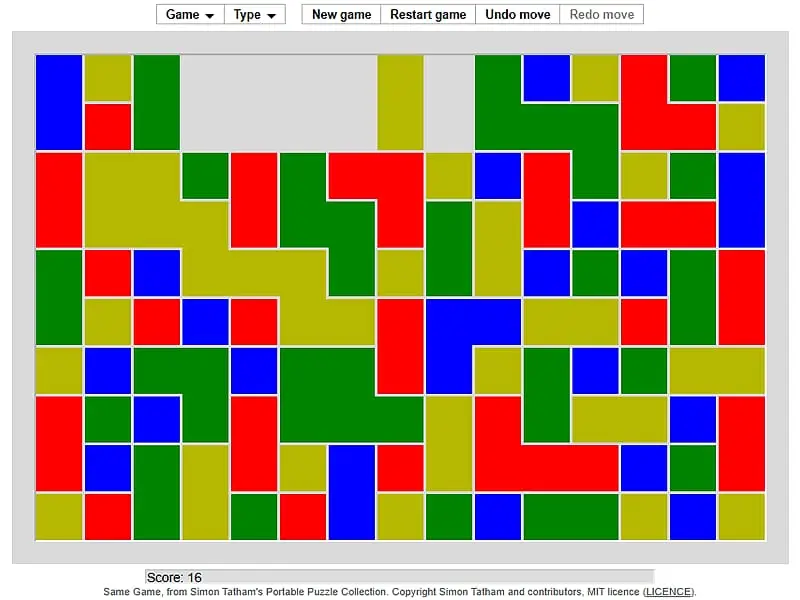
Same Game Blocks is a single-player block-clearing puzzle. You take out clusters of at least two matching squares that share edges, after which the pieces above drop and any blank column is closed in. You are trying to empty the box completely, and scoring well means clearing large clusters in one go.
- Category
- Puzzle Games
- Players
- 1 player
- Plays on
- Phone, tablet & desktop
- Input
- Mouse, Keyboard, Touch
- Made by
- James Harvey (Simon Tatham's Portable Puzzle Collection)
- Checked
Same Game Blocks is a color-clearing puzzle with gravity doing half the work. A box is packed with colored squares, and you may lift out any cluster of two or more that share an edge. Whatever sat above drops into the hole, and a column that empties entirely gets closed up by the ones beside it. The fun is in choosing what to leave alone: a color scattered across the board can be herded into one giant group worth a huge score. It is James Harvey’s entry in Simon Tatham’s puzzle collection, and it plays unblocked in your browser.
How a Turn Works
One click highlights every square linked to the one you chose. A line of text under the board reports how big the selection is and what it would score, so you can weigh options first. A second click on that cluster removes it, while clicking elsewhere simply moves the highlight.
Once a cluster is gone, anything stacked on it falls vertically. Fully empty columns disappear and the remaining ones close ranks to the left. A single square with no matching neighbour can never be taken on its own.
Empty the whole box and the game declares it COMPLETE and shows your points. When nothing but lone squares is left, the round ends.
You start on a tiny three-color 5x5 board. Bigger presets reach 20x15 in four colors, and Custom gives you control over dimensions, how many colors appear and which scoring formula is used.
Same Game Blocks controls
| To do this | Keyboard | Mouse | Touch |
|---|---|---|---|
| Highlight a group | Steer the cursor with the arrows, then Space or Enter | Left-click any square in the group | Tap any square in the group |
| Clear the highlighted group | Space or Enter a second time | Left-click the group again | Tap the group again |
| Drop the highlight | — | Right-click the group | Press and hold the group |
| Undo, redo, fresh board | U / R / N | Undo move, Redo move and New game buttons | Undo move, Redo move and New game buttons |
Early, Middle and Late Board
Early on, pick one color to be your “big group” color and avoid touching it. Clear the other colors that sit between its scattered pieces, so they slowly fall and slide together.
In the middle, work from the bottom when you can. Taking out low clusters drags the stacks above them downward, and that regularly joins pieces that started far apart. Pairs are worth nothing under default scoring, so spend them freely to reshape the board.
Late in the game, count what is left of each color. Once one square of a color is stranded with no partner left anywhere, a perfect clear is off the table. Check the preview score on a few clusters before each move, since the gap between a good and a great clear is large.
Undo and redo have no limit, which makes it easy to test an idea and roll it back.
How It Differs From Swap-and-Match Games
Unlike the tile-swapping match puzzles elsewhere on the site, nothing moves here unless gravity moves it, and no clock runs. Every decision is about the order in which you remove what is already on the board. That makes it calmer and more strategic, closer to a solitaire than an arcade game.
If you enjoy color-based logic, Flood Fill Puzzle asks you to spread one color across a grid in as few moves as you can. You can also browse more relaxed picks in casual games.
Same Game Blocks: questions players ask
How do you get a high score in Same Game Blocks?
Build one enormous group instead of many small ones. On the default setting, a cluster's value is its size minus two, squared, so twenty squares cleared together are worth 324 while two groups of ten give only 128.
Do pairs score anything?
Not on the standard formula, where a pair is worth nothing. A Custom option switches to (n - 1) squared, which pays one point for a pair. On the default setting, treat pairs as tools for rearranging the board.
Can every Same Game Blocks board be cleared?
By default, yes. The generator checks that a full clear exists. Custom can switch that guarantee off for chunkier layouts, though a full clear is no longer promised.
What happens when no moves are left?
If every remaining square is alone with no same-colored neighbour, the game shows "Cannot move" with your final score. Undo lets you step back and try a different order.
Credits and license
Same Game Blocks was created by James Harvey (Simon Tatham's Portable Puzzle Collection) and released as open source. FreezeNova hosts a lightly adapted copy on its own server, together with the original license file.
- Source code: git.tartarus.org/simon (original project)
- Code license: MIT
- Art & audio: MIT (all graphics are drawn by the game code; no images or audio)
- Our changes: Renamed for FreezeNova. This is the author's official web build with off-site links removed, scaled to our player, and with press and hold added for touch screens. The puzzle code itself is unchanged.