Konane Unblocked
Every move is a jump, and the first player with nothing left to jump loses.
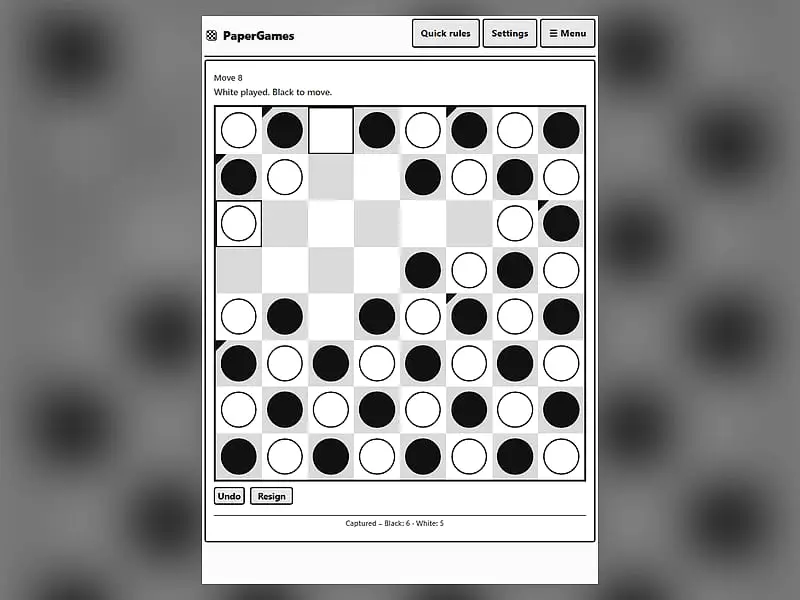
What is Konane?
Konane is a traditional Hawaiian board game for two players on an 8x8 board that starts packed with black and white stones in a checkered pattern. After removing two stones to open the board, players capture by jumping orthogonally over enemy stones. There are no other moves, and the player who cannot make a jump on their turn loses.
- Category
- Card & Board Games
- Players
- 1–2+ players (same screen)
- Plays on
- Phone, tablet & desktop
- Input
- Mouse, Touch, Keyboard
- Made by
- Christopher Müller
- Checked
Konane is an old Hawaiian game with a rule set so lean it barely needs explaining. The board starts completely full. Two stones come out, and from then on the only move in the game is a jump that captures. You never shuffle a stone to a safer square or wait for your opponent to blunder; you jump or you lose. That makes every turn a question of how many jumps you are leaving for yourself versus your rival. This unblocked version from the PaperGames project by Christopher Müller lets you play the computer at three levels or a friend on one device.
From a Full Board to the Last Jump
The opening removal. All 64 squares hold stones in a checkerboard of black and white. Black lifts a single black stone out of a corner or out of the central block of four; the legal choices light up. White answers by taking away a white stone that borders the new hole.
Jumping. Black makes the first real move. A stone leaps over an orthogonally adjacent enemy stone into the empty square behind it, and the enemy stone is taken off. Diagonal jumps don’t exist in Konane.
Chains. When the landing square offers another jump for the same stone, you may carry on, and in this version it may change direction along the way. Or hit Done jumping to end the turn. Stopping early is sometimes the smart play.
The end. Jumps are the only legal moves, so a turn that arrives with no possible jump for any of your stones means instant defeat. A score line keeps count of captured stones for both sides.
Konane controls
| To do this | Keyboard | Mouse | Touch |
|---|---|---|---|
| Lift out an opening stone | Arrow keys to reach a highlighted stone, Enter to remove it | Click one of the highlighted stones | Tap one of the highlighted stones |
| Jump an enemy stone | Arrow keys and Enter to pick the stone, then the landing square | Click your stone, then the empty square beyond an enemy stone | Tap your stone, then the empty square beyond an enemy stone |
| Finish a multi-jump before it ends | — | Click "Done jumping" | Tap "Done jumping" |
| Play against the computer | — | Click "vs Computer", pick black or white and a level, then click "New game" | Tap "vs Computer", pick black or white and a level, then tap "New game" |
| Undo a turn | — | Click "Undo" | Tap "Undo" |
Thinking Like a Konane Player
Most new players chase captures. Strong players count moves. Ask yourself after every jump: how many jumps do I still have available, and how many does my opponent have?
- Each jump opens empty squares. Before you jump, check whether those new holes give your opponent fresh jumps you did not have to give.
- Stones on the border are harder to attack, since an enemy can reach them only by running along that side. Keep a few there as a reserve.
- A long chain can be a trap. If the final landing square leaves your stone ready to be jumped back, stop one jump earlier.
- Near the end, when only a handful of possible jumps remain, count them carefully. Whoever makes the final one wins, so a quiet “spare” jump in a corner can decide the game.
- Against Hard, use Undo to replay the moment the game slipped away and try a different branch.
Who Will Like Konane
Konane appeals to people who enjoy puzzles about tempo and parity more than material. Games are short, the rules take a minute, and the strategy keeps getting deeper. It is also a nice introduction to Polynesian games for anyone curious about how board games developed outside Europe and Asia.
If you like capture-only games, Fanorona from Madagascar removes whole lines at once. For another game where running out of moves loses, try Game of the Amazons.
Konane: questions players ask
How do you start a game of Konane?
The board is completely packed, so two stones come out first. Black lifts one of its own from a corner or from the central four squares, then White removes one of its stones touching that hole. From there the first jump is possible.
Can stones jump diagonally in Konane?
No. Jumps follow rows and columns only, never slants. A stone hops over one adjacent enemy stone and lands on the empty square directly behind it.
Is capturing the most stones the way to win Konane?
Not really. The score line counts captures, but the winner is simply whoever makes the last jump. A player with fewer captures who keeps more future jumps available will often win.
Which Konane difficulty should I try first?
Easy jumps at random, which is fine for learning. Medium peeks a single turn into the future and adds some chance. Hard reads as far as three complete turns and weighs the remaining jump options for both players, so expect a real fight.
Credits and license
Konane was created by Christopher Müller and released as open source. FreezeNova hosts a lightly adapted copy on its own server, together with the original license file.
- Source code: github.com/YourChaosChris (original project)
- Code license: MIT
- Art & audio: MIT (board and stones drawn with HTML and CSS, no image or audio files)
- Our changes: We use only the Konane files from PaperGames, with the language fixed to English. The offline service worker, the language picker and links to the other games and pages were removed. Rules and computer play were not changed.