Compact Conflict Unblocked
Three moves a turn, a handful of temples and one question: who holds the most land at the end?
Tip: rotate your phone to landscape for a larger view.
What is Compact Conflict?
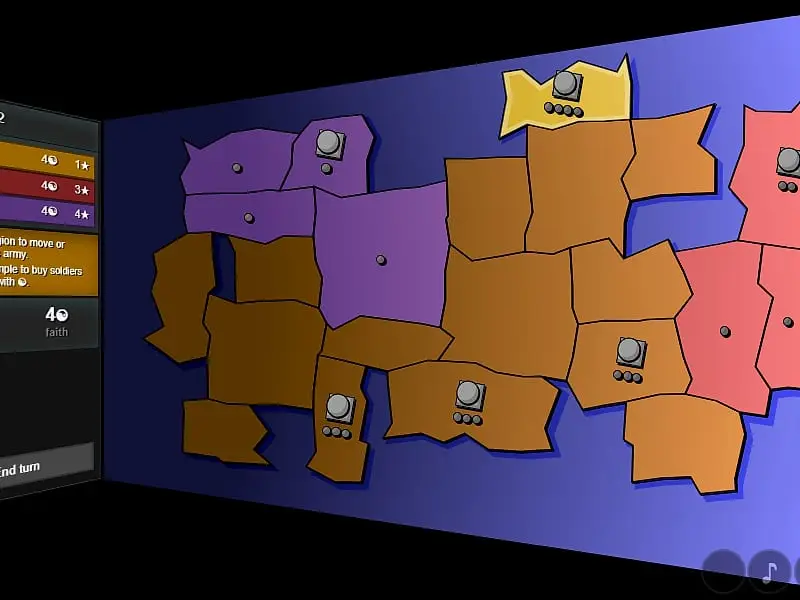
Compact Conflict is a turn-based conquest game for one to four players on a randomly generated map. Each turn you make three moves with your armies, fight over regions and spend faith at temples on soldiers or elemental upgrades. Whoever owns the most regions when the last turn ends wins.
- Category
- Strategy Games
- Players
- 1–2+ players (same screen)
- Plays on
- Phone, tablet & desktop
- Input
- Mouse, Touch
- Made by
- Jakub Wasilewski
- Checked
Compact Conflict packs a whole conquest board game into a few minutes and a few kilobytes. The map is a patchwork of odd-shaped regions drawn fresh for every match, scattered with temples. Armies march, collide and grow, but the real engine is faith: temples pump out soldiers and can be blessed with an element that quietly changes the rules around them. Jakub Wasilewski wrote it for js13kGames 2014, when the whole thing had to fit inside 13 KB. It runs unblocked here with mouse or touch, for one player against the AI or up to four around a single screen.
Setting Up and Taking Turns
The setup screen lets you assign each of four colors to a human, the AI or nobody. You also choose the AI temperament, from Nice through Rude and Mean to Evil, and a length of 9, 12 or 15 turns, or no limit. If you dislike the map, reroll it before starting.
On your turn you have three moves. A move takes some or all soldiers from one region into a bordering one. Empty land becomes yours just by entering it. Entering enemy land triggers a fight, and the region only changes hands if the whole defending army is wiped out. Soldiers that just conquered must wait until your next turn before moving again.
Ending the turn triggers your income. Every temple you own adds one soldier, and you earn faith: a point for each region plus a point for each soldier standing on a temple.
What faith buys
At any temple you hold, spend faith on more soldiers (the price rises with each purchase in the same turn) or on one of four blessings, each with two levels:
- Water increases faith income.
- Fire protects some of your attackers from losses.
- Air grants extra moves each turn.
- Earth kills one or two invaders before a battle even starts.
A temple carries just one element. If someone captures it, the blessing is theirs to lose too.
Compact Conflict controls
| To do this | Mouse | Touch |
|---|---|---|
| Pick up one of your armies | Click a region you own that still has soldiers able to move | Tap the region |
| Adjust the number of soldiers sent | Click the selected region again to cycle the count | Tap the selected region again |
| March or invade | Click a neighboring region | Tap a neighboring region |
| Recruit or bless at a temple | Click one of your temples, then a button in the side panel | Tap the temple, then a panel button |
| Take back a move, finish the turn and other options | Buttons in the side panel and the round icons at the bottom right | Tap the same buttons |
How Matches Are Won
The final count is regions, not armies. That single fact shapes good play.
Early turns. Race for neutral temples. Each is a free soldier every turn for the rest of the game, and an early lead in temples compounds quickly.
Middle turns. Keep a soldier parked on every temple. It earns faith each turn and makes a surprise grab harder. If your own soldiers fall defending, you also get four faith apiece.
Attacking. The odds swing hard toward the bigger stack, so an even trade is usually a bad trade. Waiting one turn to bring extra troops is often the strongest move.
Final two turns. Stop thinking about armies and start counting land. Spread single soldiers into every empty or lightly held region you can reach. Undo works as long as no dice were rolled, so you can test a route first.
Pick blessings that fit your plan. Water pays off in long games, Air helps a sprawling empire, and Earth makes a frontier temple a fortress.
Why It Is Worth a Few Rounds
Few browser strategy games give you this much decision-making in such a short match, and the random maps keep it fresh. The built-in five-card rules guide behind the question mark button helps first-timers. If you want a faster real-time take on conquest, try OrbitSwarm, or browse more strategy games.
Compact Conflict: questions players ask
Can I play Compact Conflict with friends?
Yes. Each of the four colors can be set to Human, AI or Off on the setup screen. Two, three or four people can pass one computer or tablet around, and you can fill empty seats with computer players.
How hard is the computer?
There are four settings named Nice, Rude, Mean and Evil. Nice is forgiving and good for learning the temple rules, while Evil attacks with sharp timing and punishes thin borders.
How long does a game take?
You choose 9, 12 or 15 turns, or an endless game that runs until one side owns everything. Shorter limits make for quick matches, while longer ones give temples more time to pay off.
Are battles random?
Partly. Each fight is decided by chance, but the odds shift strongly toward the bigger army. Bringing clearly more soldiers than the defender is the reliable way to win, and Fire and Earth upgrades tilt fights further.
Credits and license
Compact Conflict was created by Jakub Wasilewski and released as open source. FreezeNova hosts a lightly adapted copy on its own server, together with the original license file.
- Source code: github.com/krajzeg (original project)
- Code license: Zlib
- Art & audio: Zlib (map, temples and soldiers drawn with HTML and CSS; sound effects generated in code)
- Our changes: We renamed the script file, changed the author's website link into plain text, and delayed sound effects until your first click. The rules are as the author wrote them.