City Shield Unblocked
Pick the spot, let the fireball bloom, and keep one city glowing through the next wave.
Tip: rotate your phone to landscape for a larger view.
What is City Shield?
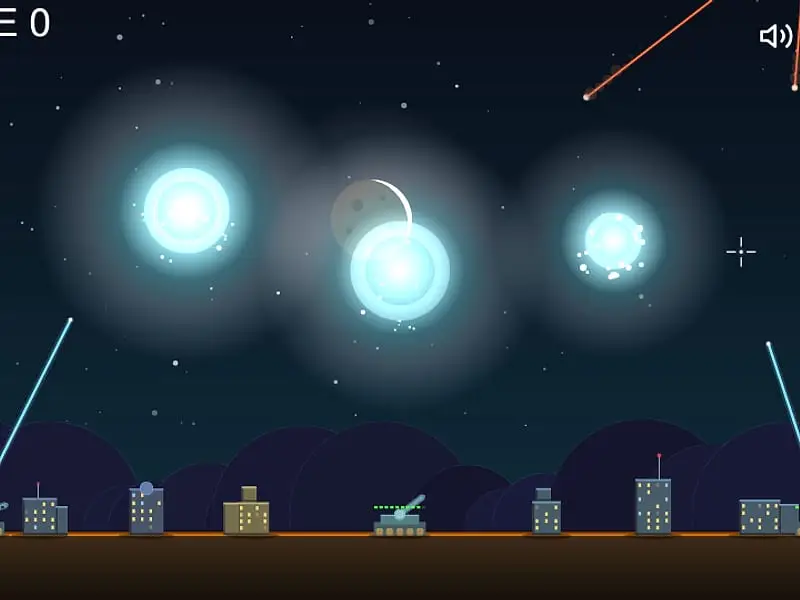
City Shield is a missile-defense arcade game. You click points in the night sky, and the nearest of three ground cannons sends a shot that bursts into a short-lived fireball, destroying anything that drifts into it. The goal is to keep your six cities standing through wave after wave and push your score as high as it will go.
- Category
- Arcade Games
- Players
- 1 player
- Plays on
- Phone, tablet & desktop
- Input
- Mouse, Touch, Keyboard
- Made by
- Frank Force
- Checked
City Shield turns the night sky into a test of prediction. Warheads slide down toward six tiny cities, and your only answer is to choose a point in the air where your own shot will burst. The fireball hangs there for a moment, so the real skill is guessing where a threat will be when that bloom is at full size. This build, first released as Missile Defense, comes from the LittleJS Arcade collection by Frank Force, and you can play it unblocked here with a mouse or a fingertip.
Three Launchers and a Skyline to Save
Your defense is a row of three cannons tucked between the cities. Each one gets ten rounds per wave. You never pick which cannon fires: you click a spot, and the launcher closest to it horizontally that still has ammo takes the shot. The middle launcher fires faster rounds than the two on the flanks.
Wave one sends ten warheads. Every new wave adds three more and nudges up their speed. Not every missile wants a city. Some dive at your cannons, and a launcher that gets hit stays wrecked until the game ends. Any cannon still standing is restocked when the next wave begins.
The threats also get smarter. Bombers and satellites start crossing the screen in wave two and release their own missiles mid-flight. Wave three brings warheads that split into two or three pieces. From wave five, smart bombs slip sideways to avoid your blasts. When the last city falls, the game is over.
How the Score Adds Up
A plain warhead is worth 25 points, a plane or satellite 100 and a smart bomb 125. Those numbers are multiplied by the wave bonus, which sits at one for waves one and two, doubles for waves three and four, and then climbs by one every second wave until it caps at six.
Between waves the game tallies leftover rounds and surviving cities, again with the multiplier applied. Crossing each 10,000 points earns an extra city. If one is in ruins it rises again at once; if all six are fine, the spare is held back for the next one that gets hit.
City Shield controls
| To do this | Keyboard | Mouse | Touch |
|---|---|---|---|
| Send a shot to a spot in the sky | — | Left click the target point | Tap the target point |
| Pause the action (restart is offered there too) | Esc | — | — |
| Start a brand-new game | R | — | — |
| Move through the title menus | — | Click PLAY, OPTIONS or HELP | Tap the menu buttons |
Mistakes That Lose Cities
- Clicking right on the missile. By the time the blast grows, the target has moved past it. Aim slightly ahead along its path.
- One shot per warhead. Missiles often travel in loose groups. A single well-placed burst in the middle of a cluster saves several rounds.
- Waiting on split missiles. Catch a splitter high in the sky. Once it breaks apart, you need up to three shots instead of one.
- Ignoring attacks on the center cannon. Its quick rounds are your best tool against late, fast waves, so treat any missile heading for it as top priority.
- Defending rubble. A missile falling toward a city that is already gone cannot do further harm. Let it land and spend the round elsewhere.
- Spraying shots in the last seconds. Every unused round pays out at the wave tally, so stop firing once the sky is clear.
Why It Works So Well in Short Sessions
A single wave lasts under a minute, yet the multiplier and bonus cities give a long run real stakes. It suits anyone who likes calm aiming more than twitch reflexes, and it plays just as well with a tap as with a click. If you like defending against things falling from above, Planet Protector is a faster take with a ship you fly yourself, and Rock Blaster swaps cities for drifting space rocks. More classics wait in our arcade games section.
City Shield: questions players ask
Does City Shield ever end, or can you play forever?
A run keeps going as long as at least one city survives. Each wave brings more and faster threats, so sooner or later the sky wins. The goal is a bigger score and a later wave than last time, and your best result is saved.
Why do my shots keep missing the missiles?
Your rounds need a moment to climb, and the fireball takes a moment to grow. Aim at the point a warhead will reach, a little below it, rather than the point where you see it now. Targets near the middle cannon are the easiest to reach.
What happens when a cannon gets hit?
That launcher is gone for the rest of the game, with no reload. The other two still refill to ten shots at the start of each wave, but losing one makes long stretches of the skyline much harder to cover.
Can I play City Shield on a phone or iPad?
Yes. Tapping the sky works exactly like clicking. The field is wide, so turn the device sideways to get bigger targets and more room for your thumbs.
Credits and license
City Shield was created by Frank Force and released as open source. FreezeNova hosts a lightly adapted copy on its own server, together with the original license file.
- Source code: github.com/KilledByAPixel (original project)
- Code license: MIT
- Art & audio: MIT (city skyline, cannons and effects drawn in code; sounds generated in code)
- Our changes: We gave it a new name (it was called Missile Defense), gathered the engine files into a single folder and changed the wording of one code comment. The way it plays is the same.