SpacePi Unblocked
Drag a line, block the streak, grow the base. Fewer lines means a better score.
Tip: rotate your phone to landscape for a larger view.
What is SpacePi?
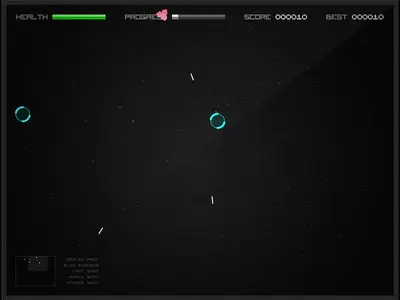
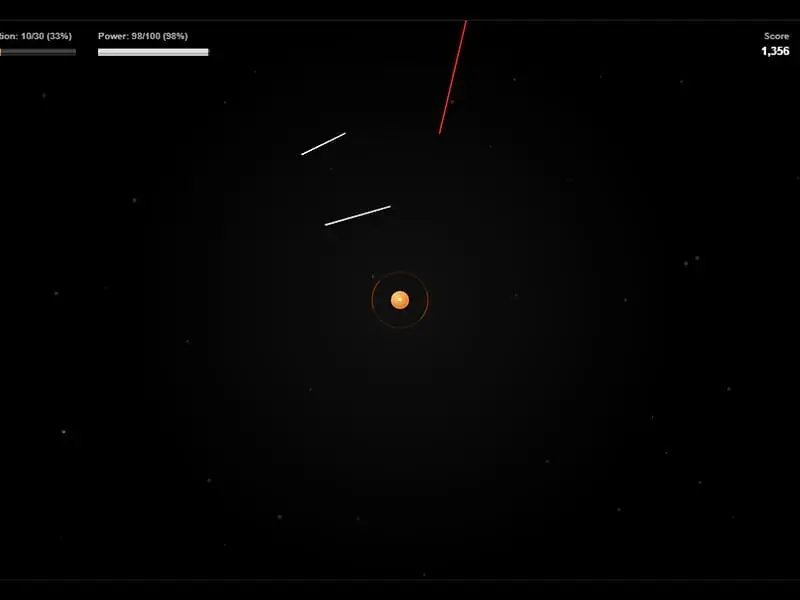
SpacePi is a defense game by Jack Rugile played entirely by drawing lines. You drag short white lines across the paths of red enemy streaks to protect a small orange base while it grows to a target size. Each of the 13 levels pays coins for upgrades, and the best result is the lowest score, earned by finishing fast with few lines and no hits.
- Category
- Arcade Games
- Players
- 1 player
- Plays on
- Best on desktop, playable on touch
- Input
- Keyboard, Mouse, Touch
- Made by
- Jack Rugile
- Checked
SpacePi asks you to defend something without shooting at all. A tiny orange base sits in the middle of the screen, red enemy streaks race inward from every side, and you block them by sketching short white barrier lines in their way. Each time a streak crosses one of your lines, both burst apart. Meanwhile the base swells toward a goal size. Jack Rugile built it for the js13kGames contest, where everything must fit in 13 kilobytes, and every shape is drawn in code. It plays unblocked here, best with a mouse.
The Goal of Each Level
From the main menu, open the upgrade screen and choose one of thirteen levels lined up along the bottom. Only the first is unlocked to begin with, and each win unlocks one more.
At first the base is barely a dot. A Completion bar along the top tracks its progress toward the required size, and that requirement grows on later levels. Every red streak that reaches the base bites a piece off it. Let it shrink to nearly nothing and the level fails. Grow it to full size and you win.
Power, Coins and Power-Ups
Lines are not free. Each one drains power in proportion to its length, shown on the Power bar, which refills slowly.
Broken streaks often leave coins behind, and sometimes a power-up. They drift toward your pointer when it gets close, not toward the base. Later levels pay more per coin.
Spend coins on ten upgrade tracks of five steps each, covering things like power capacity, power recharge, base toughness, magnet strength and better drops. The four power-ups either slow the attackers, remove the power limit, speed up base growth twofold or scatter a shower of coins. Your browser keeps your coins, upgrades, records and stats.
SpacePi controls
| To do this | Keyboard | Mouse | Touch |
|---|---|---|---|
| Draw a blocking line | — | Click and drag across the screen | Drag a finger across the screen |
| Collect coins and power-ups | — | Hover the pointer close to them | Touch close to them |
| Pause and unpause | Space | — | — |
| Shop for upgrades and choose a level | — | Click the buttons | Tap the buttons |
Strategy: Spend Less, Score Less
Because a low score wins, efficiency is the whole game.
- Draw near the threat. A short line just ahead of a streak costs less power than a long wall, and blocks just as well.
- Protect the opening seconds. The base is at its smallest at the start, and a single early hit can sink a level. Watch every edge from the first moment.
- Sweep for coins between attacks. Drag the pointer toward drops in quiet moments, since the magnet follows you, not the base.
- Buy power upgrades first. Capacity and recharge set how much you can draw when several streaks arrive together.
- Farm an easy level if you are short. Replaying a cleared level is a low-risk way to earn coins for the next upgrade.
- One good line beats three rushed ones. Every line adds 100 to your score before length is even counted.
A Clever Twist on Defense
SpacePi feels part puzzle, part reflex test, with an upgrade loop that rewards coming back. It suits players who like neat, efficient solutions. For more drawing-based play try Coil, or defend from the ground in City Shield.
SpacePi: questions players ask
How is the score counted in SpacePi?
Lower is better. The score adds your time in seconds, 100 for each line drawn, the total length of all your lines and 500 for every hit your base takes. A quick finish with a handful of short lines and no damage gives the best number.
How do I get a P on a level?
The P stands for Perfect. You earn it by finishing a level with zero hits on your base. The level picker keeps a tally of cleared levels and Perfect ones out of 13.
Why do my lines run out partway?
Drawing spends power equal to the line's length, and you begin with just 100 power. When it is low, the line simply ends early. Power refills over time, and two upgrades raise its maximum and its recharge speed.
Is SpacePi good on a phone?
It works, but it is not ideal. Touch drawing and menu taps are supported, yet pausing needs a keyboard and precise lines are harder with a finger on a small screen. A mouse on a laptop gives the best results.
Credits and license
SpacePi was created by Jack Rugile and released as open source. FreezeNova hosts a lightly adapted copy on its own server, together with the original license file.
- Source code: github.com/jackrugile (original project)
- Code license: MIT
- Art & audio: MIT (no image or sound files; everything is drawn in code)
- Our changes: We made the game frame resize to fit the player, added drawing by touch and replaced the credit links with plain text. The game itself was not changed.